
Training Mindset after 50, 60, 70 and beyond isn’t simply about how much weight you can lift.
Bench Press Mindset is one example of how determination and judgment influence a challenging repetition. It’s about the strength mindset behind a difficult lift, the decision to continue through a sticking point. Then recognizing when to surrender because technique must take priority over perseverance.
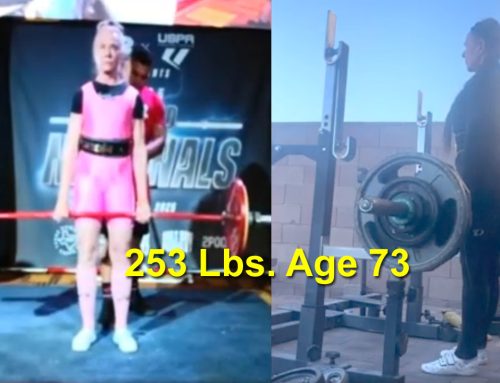
As a 73-year-old World Champion Powerlifter, I’ve experienced plenty of challenging lifts. Some days, familiar weights move predictably. Other days, even a weight I’ve handled repeatedly demands maximum effort.
My recent bench press workouts provide a revealing example of how a strong training mindset drives me toward bench press lockout. Lockout constitutes the finish.
Training mindset matters. To grind or not to grind? That is the question!

To grind or not to grind? Debra Stefan explores determination, technique, and the decision to fight for bench press lockout.
This video documents three training dates, showing four bench press efforts and the decisions involved in reaching lockout.
Rather than presenting a perfect demonstration of competition technique, I’m examining what happens when a challenging repetition becomes a test of determination, strength, and judgment.
Bench Press for Older Adults: Three Training Dates, Different Results
My training log illustrates how much performance can fluctuate, even with decades of competitive lifting experience.
| Training Date | Bench Press | Observation |
| September 12, 2026 | 125 lb × 1 | Grinder to lockout |
| November 1, 2026 | 120 lb × 1 | Grinder to lockout |
| November 8, 2026 | 115 lb × 2 | First rep clean; second requires glute bridge |
| November 8, 2026 | 117 lb × 1 | RPE 10 grinder to full lockout |
My training history includes repeated successful 125-pound singles. Yet on November 8, 117 pounds require everything I have available that day.
The difference between 125 and 117 pounds is only eight pounds, but the perceived effort can be dramatically different. Particularly since I weigh 148 pounds and am a 73-year-old female.
That’s one reason I use the Rate of Perceived Exertion (RPE) scale to evaluate training intensity.
RPE Training Mindset: Calculate, Prepare, Execute
A strength training mindset requires continuous evaluation and adjustment.
Before a challenging lift, I calculate my estimated one-rep maximum to establish a limit I don’t plan to exceed. I select my working weight to target RPE 8–9, leaving one or two repetitions in reserve.
RPE measures how difficult a set feels relative to the lifter’s available capacity.
- RPE 8: Approximately two repetitions remaining.
- RPE 9: Approximately one repetition remaining.
- RPE 10: Maximal effort, with no additional repetition available.
Mental preparation begins with a realistic prediction. The goal is to execute with confidence, control, and determination.
However, strength and readiness can change throughout a training session. Each completed set provides another benchmark. I reassess my RPE, bar speed, and technique before selecting the next weight. My original calculation is a guide, not a guarantee.
A grinder is a repetition in which bar speed slows significantly as the lifter works through a sticking point.
A slow repetition doesn’t automatically indicate failure. However, a stalled bar, loss of control, or unsafe positioning can make terminating the attempt the appropriate decision.
The important distinction is between a controlled, difficult repetition and an attempt that has become unsafe. That is when you decide to surrender instead of persevere.
Why I Used a Glute Bridge to Complete a Bench Press
During my November 8 session, the first repetition at 115 pounds was clean.
The second repetition became more difficult. I elevated my hips into a glute bridge, changing my leverage to complete the movement through the bench press lockout.
Why not immediately settle the bar onto the safety rails?
At that moment, I still had control of the bar and chose to complete a modified training repetition.
That decision is not the same as recommending glute bridging as standard bench press technique.
In competition, the buttocks must remain in contact with the bench under the applicable rules. Elevating the hips invalidates the lift.
A glute bridge changes the mechanics of the press. It does not guarantee a safer or more effective repetition, and safety rails remain essential when a lift cannot be controlled.
For me, the modified repetition raised a broader question: What is the value of completing a difficult movement when the result is no longer competition-standard?
The answer depends on the purpose of the training session, the lifter’s experience, and the ability to maintain control.
Training Mindset: Determination Versus Surrender
Determination is an important part of developing a strong strength mindset through consistent training.
Experienced lifters understand the mental challenge of a heavy barbell. Commitment, concentration, and confidence can influence how a difficult repetition unfolds.
But determination isn’t the same as refusing to acknowledge physical limitations.
There are times when grinding through a controlled sticking point is a reasonable training decision. There are also times when ending the attempt is the better choice.
The goal is not to complete every repetition at any cost. It’s to develop the judgment to recognize when continued effort is productive.
A productive training mindset also recognizes that adjusting a workout is not the same as abandoning a goal.
This distinction becomes especially important when training for strength maintenance and longevity.
Training Mindset: I Got It, I Got It, I Ain’t Got It!
Remember that classic Mel Brooks comedy routine? “I got it! I got it! I ain’t got it!”
That familiar punchline inspired my safe lifting series, featuring my own squat and bench press demonstrations of safe bailout techniques.
The humor delivers a serious lesson: knowing when to surrender a lift is just as important as knowing when to fight for it. A successful safety bail demonstrates skill, preparation, and sound judgment—not defeat.
Why Does Strength Fluctuate Between Workouts?
My November 8 bench press performance was below what I’d demonstrated in previous sessions.
That doesn’t automatically mean I had lost strength.
Several factors can influence day-to-day performance:
Emotional Stress and Mental Fatigue
Emotional stress can affect concentration, sleep, perceived exertion, and recovery.
The demands of everyday life don’t disappear when we enter the gym. Psychological stress may contribute to a session feeling unusually difficult.
Sleep and Recovery
Poor sleep and accumulated fatigue can influence readiness for heavy training.
Recovery is an essential component of strength maintenance, particularly when training near maximal intensity.
Nutrition and Hydration
Inadequate fueling or hydration can affect energy, endurance, and perceived effort during a workout.
Normal Performance Variability
Even highly trained athletes experience differences in strength and bar speed from one session to another.
A single difficult workout isn’t sufficient evidence of a lasting decline.
Strength Maintenance After 70 Is Not About Setting Records Every Session
My competitive powerlifting background has taught me to distinguish between testing strength and maintaining it.
At 73, I don’t need to establish a new personal record every time I train.
Instead, I want to preserve the strength I’ve developed, maintain technical proficiency, and continue challenging myself appropriately.
That requires balancing training intensity with recovery and recognizing that a difficult session may call for adjustments.
The ability to maintain strength over decades is a greater achievement than any single workout.
For older adults beginning resistance training, the objective is different from that of an experienced competitive powerlifter. Building sound technique, developing confidence, and progressing gradually should take precedence over maximal-effort grinding.
What Can Masters Lifters Learn From a Difficult Bench Press?
My three training dates demonstrate that the same lifter can experience substantially different levels of effort with relatively small changes in weight.
They also demonstrate why RPE, technique, and training history deserve consideration alongside the number on the bar.
A completed modified repetition is not the same as a competition-standard lift. A difficult grinder is not necessarily a failed attempt. And choosing to use safety rails is not a failure of determination.
Understanding those distinctions is part of becoming a knowledgeable strength athlete.
How Training Mindset Supports Fitness Retreat Success
The same principles apply to people beginning a weight-loss or fitness journey. Progress requires more than motivation. It requires consistency, patience, accountability, and the willingness to make adjustments when circumstances change.
At Vegas Fitness Retreats, I apply these principles through individualized strength training, daily activity, and practical coaching. Each client begins with different abilities, experiences, and goals.
A successful training mindset is not about comparing yourself with an experienced powerlifter. It’s about learning to challenge yourself appropriately, building confidence through achievable progress, and developing habits you can maintain after returning home.
That is an important part of my personalized approach to fitness and weight-loss retreats.
To Grind or Not to Grind? Join the Discussion
I believe mindset is an important component of strength training, but it must be balanced with technical judgment.
My November 8 workout reminded me that familiar weights can become unexpectedly demanding.
One difficult training day doesn’t erase years of demonstrated strength.
I’m interested in hearing from other experienced lifters:
When a bench press becomes a grinder, what determines whether you continue fighting for lockout or concede the repetition?
Develop Your Training Mindset With Expert Coaching
A strong lifting mindset develops through experience, technical knowledge, and sound training decisions.
Whether you’re learning the fundamental barbell lifts or refining years of lifting experience, individualized coaching helps you understand when to challenge yourself, when to adjust technique, and how to manage training intensity.
As a World Champion Powerlifter and USPA Nationally Certified Powerlifting Coach, I offer private strength training through Vegas Fitness Retreats and live Zoom coaching.
Explore personalized strength training with Debra Stefan to develop confidence, technical proficiency, and a sustainable approach to getting stronger.
Share your perspective in my Reddit community, r/PowerliftingOver70, where lifters can discuss strength training, technique, and longevity.
About Debra Stefan
Debra Stefan is a World Champion Powerlifter, USPA Nationally Certified Powerlifting Coach, and fitness professional with over 40 years of experience. She provides individualized strength coaching and fitness instruction, including live Zoom training.
Continue Learning
- Weight Lifting for Weight Loss: Learn the Big Three
- Back Strength Exercises for Seniors
- Strength Training for Seniors
- Explore private Zoom strength coaching with Debra Stefan.


Leave A Comment
You must be logged in to post a comment.