

At 73, Debra Stefan performs 135-pound bent-knee barbell calf raises after hip replacement, Achilles repairs and bunionectomies—and still runs, jumps rope and wears stilettos.
Foot and Ankle Exercises for Seniors: Barbell Stilettos @73

The payoff: strong feet and ankles for five-inch stilettos at 73.
Foot and ankle exercises for seniors do not have to be limited to seated movements or gentle ankle circles. They should begin at an appropriate level, but progressive resistance can help older adults build the strength, control and confidence needed for walking, running, jumping rope and other demanding activities.
Impact work also has implications beyond the feet and ankles. Read more about the importance of impact exercise for bone density after 65.
What does a 135-pound barbell have to do with walking confidently in five-inch stilettos at age 73?
For me, the connection begins at the feet.
The History Behind My Feet, Achilles and Hip
My three complete bunionectomy surgeries were closely connected to the demands of my professional dance career.
The right Achilles rupture happened while performing a freestyle jump-rope routine for the USA Jump Rope Championship. At takeoff, the force produced by my muscle overpowered the tendon, and the Achilles exploded away from the heel. The sound was unforgettable. Surgical reattachment was required, and when the first repair did not heal correctly, the entire procedure had to be performed again.
Years later, I was trail running down a steep slope when my foot suddenly dropped into a hole. I heard another distinct noise at impact. After the Achilles explosion, I already knew that noises like that were not good. That accident eventually led to my left total hip replacement.
My surgical history is therefore:
- Three complete bunionectomy surgeries
- Two right Achilles tendon reattachment surgeries
- One left total hip replacement
Despite that history, I continue to run, jump rope, powerlift and wear five-inch heels.
That did not happen by avoiding resistance. It came from years of gradually rebuilding strength and control.
Strength, Style and Self-Esteem After 70
For many women, clothing and footwear are part of self-expression. Continuing to wear heels can represent more than appearance—it may preserve confidence, femininity, personal style and a sense of continuity with the woman she has always been.
Thoughtfully progressed foot strengthening exercises for seniors can help preserve the stability and control needed for personal choices, including footwear. Likewise, ankle strengthening exercises for seniors can support balance and confidence in everyday movement.
For me, five-inch stilettos are not a requirement for aging well. They are a choice I am still physically capable of making. After multiple hip, Achilles and foot surgeries, retaining that choice supports my self-esteem and reminds me that growing older does not require surrendering strength, glamour or individuality.
The foot and ankle exercises for seniors described here are intended to support physical capability. The stilettos are simply my personal payoff.
An Advanced Example of Foot and Ankle Exercises for Seniors
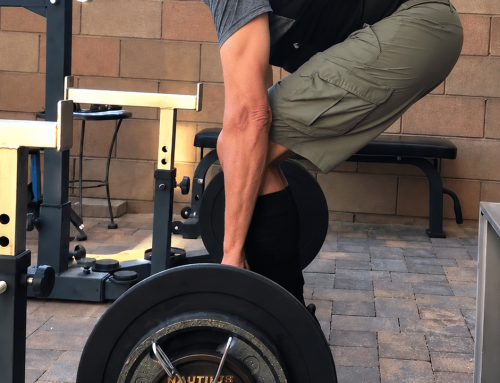
The video above shows five repetitions of a movement I describe as the barbell bent-knee heel-drop raise to lockout, performed with 135 pounds. Warm up sets begin with the empty 45-pound Olympic barbell into descending repetitions and ascending loads. Such is progressive strength training. A riser adds the essential heel drop to begin each rep below neutral for a full range of motion from start to finish.
This is not a conventional calf raise, and it is not a beginner exercise. It combines:
- Loaded ankle plantar flexion
- A deeply flexed knee position
- A pause at peak heel elevation
- Knee and hip extension to lockout
- Core bracing and balance
- A slow, controlled return
The feet remain actively involved throughout the entire repetition. The forefeet must maintain secure pressure against the riser while the ankles, calves, knees, hips and trunk coordinate the movement. The bent-knee calf raise is a major foot strengthening exercises for seniors, but it must begin unweighted.
How to Perform the Bent-Knee Heel-Drop Raise to Lockout
1. Establish the starting position
Place the forefeet securely on a stable riser.
Allow the heels to drop below the level of the platform while deeply flexing the knees into a position similar to a sissy squat. The torso remains braced and the feet stay firmly connected to the riser.
2. Elevate the heels with the knees bent
Raise the heels as high as possible while maintaining the bent-knee position.
Knee angle changes how the calf muscles contribute to plantar flexion, that is full elevation for peak muscle contraction. The gastrocnemius crosses both the knee and ankle, while the soleus crosses the ankle but not the knee. Flexing the knee reduces the gastrocnemius contribution and changes the demands placed on the calf complex.
3. Pause at peak heel elevation
Hold the highest stable heel position while keeping the knees flexed.
During this pause, the quadriceps—including the vastus medialis—help control and stabilize the bent-knee position under load.
The pause is deliberate. It prevents the exercise from becoming a quick bounce between the heel raise and lockout.
4. Maintain the peak heel raise through lockout
Keep the heels elevated while extending the knees and hips to full lockout.
Do not allow the heels to drop during the transition.
This requires the calf contraction to remain active while the quadriceps and hips complete the lockout.
5. Pause again at full extension
At the top, hold:
- Peak heel elevation
- Full knee and hip extension
- Firm forefoot pressure
- Core bracing
- Balance under the bar
6. Reverse the sequence slowly
Bend the knees while continuing to control the elevated heel position, then lower the heels into the starting position.
The return should be deliberate rather than a sudden drop.
Why Both the Feet and Ankles Matter
It would be incomplete to describe this only as a calf exercise. Barbell calf raises, expecially with bent-knee are powerful ankle strengthening exercises for seniors.
The feet create the base of support. They must remain stable against the riser while pressure is managed through the forefoot. The ankles produce and control the heel elevation. The calf–Achilles complex transfers force between the lower leg and heel.
The gastrocnemius and soleus together form the primary plantar-flexor muscle group. They contribute to posture, propulsion and activities such as walking, running and jumping.
Research in older adults also supports including foot and ankle exercise when the goals include ankle strength, mobility, balance and gait stability.
My loaded barbell version is one advanced example—not the only useful foot and ankle exercise for seniors.

Calf and Achilles anatomy for senior foot and ankle strengthening exercises
Why the Bent-Knee Position Is Different
My loaded barbell version is one advanced example—not the only approach to foot strengthening exercises for seniors or ankle strengthening exercises for seniors.
A straight-knee calf raise and a bent-knee calf raise are not interchangeable.
The gastrocnemius and soleus form the primary plantar-flexor muscle group and contribute to posture, propulsion, walking, running and jumping.
Because the gastrocnemius crosses the knee, changing knee position changes its length and mechanical contribution. The soleus does not cross the knee and continues to plantar-flex the ankle when the knee is flexed. Research comparing knee-flexed and knee-extended calf training confirms that knee position changes the muscular demands of plantar flexion.
That is why my lower-leg training includes both:
- Straight-knee heel-drop raises to lockout
- Bent-knee heel-drop raises to lockout
The goal is not to pretend one variation completely isolates one muscle. The goal is to train the calf complex through different joint positions.
Achilles Loading Requires Progression
Heel raises are commonly used to load the Achilles tendon, but different variations can place very different demands on it. Progressive lower-leg work is part of a broader approach to strength training for seniors.
Research has found that Achilles tendon loading varies substantially according to exercise selection, body position and external load. Seated and bilateral heel raises generally produce less tendon loading than more demanding weight-bearing and hopping exercises.
That distinction is particularly important in my case because my right Achilles required two surgical reattachments.
The 135-pound set shown in the video is not rehabilitation advice and should not be copied by someone who is newly recovering from an Achilles injury or surgery.
It is the result of long-term progression.
Foot Strengthening Exercises for Seniors
Effective foot strengthening exercises for seniors should improve forefoot pressure, toe control, balance and the ability to stabilize the body during walking, running and loaded exercise.
Ankle Strengthening Exercises for Seniors
Progressive ankle strengthening exercises for seniors can help develop plantar-flexion strength, ankle control and confidence during impact activities such as running and jumping rope.
How Seniors Should Begin
Most foot and ankle exercises for seniors should begin unweighted and with stable hand support. The advanced barbell variation shown here demonstrates what may become possible after progressive training; it is not the appropriate starting point for most people.
The correct starting point is not a barbell.
Begin unweighted while holding a secure support.
Beginner version
- Place the forefeet on a low, stable riser.
- Hold a railing, rack upright or other immovable support.
- Bend the knees only as far as comfortably controlled.
- Raise the heels while maintaining the knee position.
- Pause briefly.
- Extend toward standing without allowing the heels to collapse.
- Lower slowly.
The support allows the learner to focus on foot pressure, ankle movement and knee control without turning the exercise into a balance test.
Progression
Advance only when each stage is stable and pain-free:
- Unweighted with two hands on support
- Unweighted with lighter hand assistance
- Greater controlled range of motion
- Additional repetitions
- Light external resistance
- Gradual loading over time
The purpose is not to imitate my 135-pound set. The purpose is to improve the ability that the individual currently has.
The Role of Core Bracing and Balance
Core balance belongs in the discussion, but it is not the primary focus.
With a barbell on the back, the trunk must remain braced while the center of pressure changes through the feet. The lifter must control the bar as the knees move from deep flexion to full extension.
That creates a significant balance and coordination challenge.
However, the movement should never become a balancing stunt. The feet should remain securely supported, and beginners should hold something stable until the sequence is dependable. Every rep maintains a lean path of control from bottom to top. However, a sudden loss of balance merely calls for a reactionary catch step. So, it is self-spotting.
Why Foot and Ankle Exercises for Seniors Matter
Effective foot and ankle exercises for seniors should address more than one isolated muscle. The feet provide the base of support, the ankles control movement, and the calf–Achilles complex helps absorb and produce force.
Research examining foot and ankle exercise programs for older adults reports potential benefits for strength, mobility, balance and gait-related outcomes.
Strong feet and ankles are not only about preventing decline.
They support the activities that make life feel physically capable:
- Walking with confidence
- Rising onto the toes
- Managing stairs
- Running
- Jumping rope
- Absorbing and producing force
- Maintaining balance
- Participating in strength training
Foot and ankle exercise programs have shown potential to improve several motor outcomes associated with mobility and fall risk in older adults. Results vary according to the exercise program and participant.
My goal extends beyond basic mobility. I want enough lower-leg strength and control to continue doing demanding things. Personally, I don’t easily resign to give up if I can realistically continue with intention.
My Personal Outcome
I do not claim that this one movement caused every ability I retain.
It is one part of a larger strength-training practice that has helped me continue to:
- Run
- Jump rope
- Squat and deadlift
- Manage heavy loads safely
- Walk confidently in five-inch stilettos
The stilettos are not proof of medical recovery, nor are they a training recommendation for everyone.
They are my personal demonstration that strength can preserve choice, confidence and style.
Minimal Equipment for the Demonstration
For the 135-pound set, I used:
- Deadlift slippers
- A mouth guard
The slippers give me a thin, direct connection with the riser and floor.
I personally wear a mouth guard during demanding strength challenges because I tend to clench my teeth under load. That is an individual choice rather than a requirement for performing the movement.
The most useful foot and ankle exercises for seniors are those that begin at the person’s current ability and progress toward the activities that matter in everyday life.
Strength With a Purpose
Training after 70 does not have to be limited to maintaining the bare minimum.
A sensible starting point, appropriate support and gradual progression can allow older adults to improve meaningful physical abilities.
For one person, that may mean walking farther.
For another, it may mean recovering confidence on stairs.
For me, it means continuing to powerlift, run, jump rope—and finish a 135-pound calf-strength video by walking away in five-inch stilettos.
The stilettos are the payoff. The strength is what makes them possible.
Continue Reading
- Strength Training for Seniors
- Powerlifting Over 70
- Senior Fitness Retreat in Las Vegas
- Strength Training for Weight Loss
- Bone Density and Impact Exercise After 60
Could your current exercise program support the life you still want to be living ten years from now?
Learn more about private, individualized strength and fitness coaching at my residential fitness retreat in Henderson, Nevada. Private, individualized training is available through my senior fitness retreat in Las Vegas.


Leave A Comment
You must be logged in to post a comment.